
Best Seattle Neighborhoods for Airbnb & STR Investment: 2026 ROI Analysis
Quick Summary:
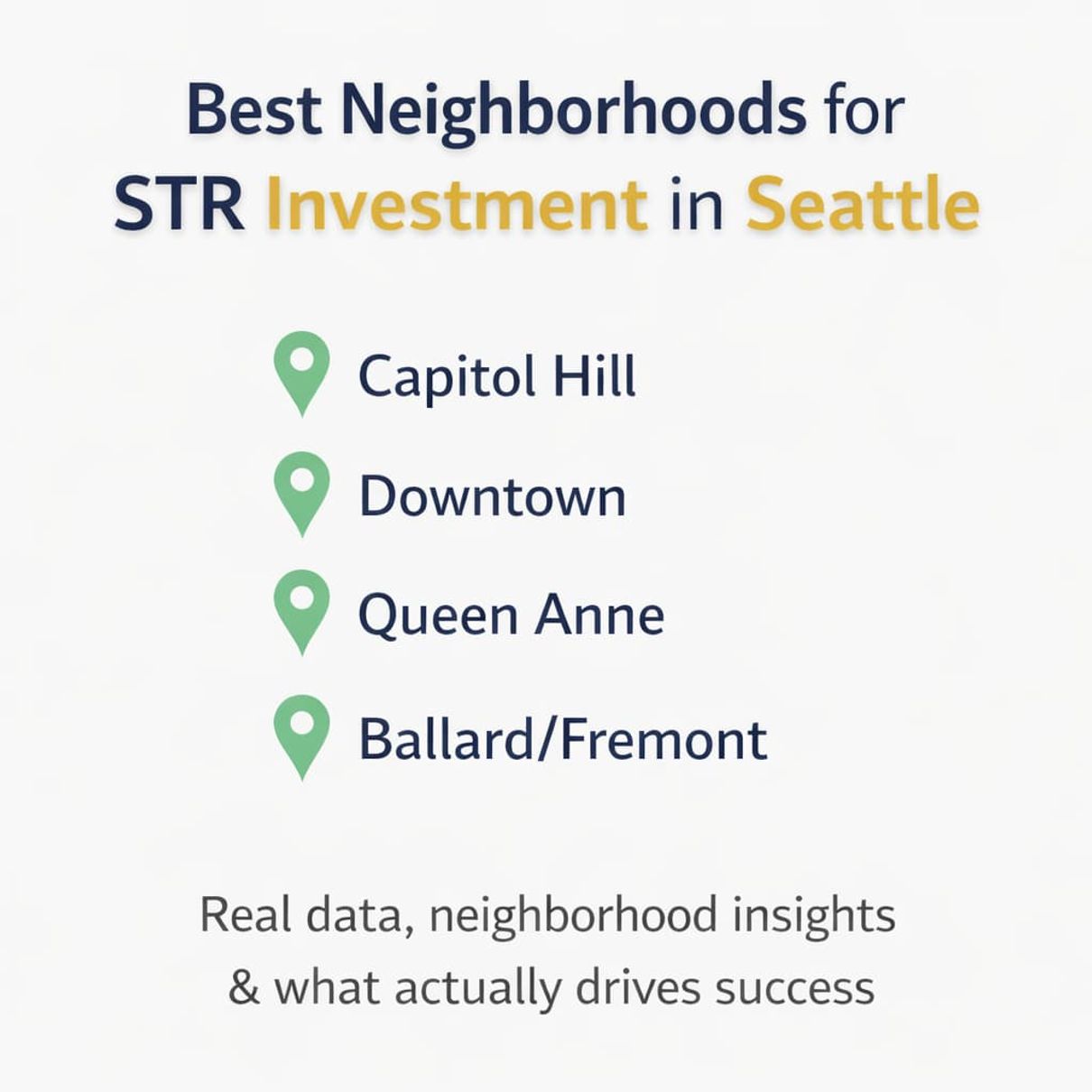
Seattle’s strongest neighborhoods for short-term rental (STR) performance include Capitol Hill (culture and nightlife, ~$170–200 ADR for well-managed 2-beds), Downtown/Pike Place Market (tourism and conventions, ~$220–280 ADR), Queen Anne (family and premium stays, ~$250–350+ ADR for larger homes), and Ballard/Fremont (local character with more stable year-round demand, ~$160–195 ADR). However, neighborhood alone does not determine success. Within the same ZIP code, property-specific factors such as parking, views, unit layout, and professional presentation routinely create 40–50% performance variance. Top-performing properties outperform the median not by luck, but through deliberate property selection and operational execution.
Let’s be direct about STR investment advice in Seattle: most “best neighborhoods” articles are tourism guides disguised as financial analysis. They tell you where people like to visit, not where owners actually make money.
Yes, Pike Place Market is iconic. Capitol Hill is lively. Queen Anne has great views. All true. But none of that explains why a $650,000 condo on 15th Avenue underperforms a $525,000 unit in Wallingford, or why two properties on the same block can deliver dramatically different returns.
This guide is written from an operator’s perspective. We’re breaking down Seattle neighborhoods based on what actually drives STR revenue: guest demand profiles, booking behavior, property attributes that command premium rates, and the operational realities that separate consistently profitable properties from underperformers.
Here’s the reality most investors don’t hear early enough:
Two properties in the same neighborhood, on the same street, can differ in annual revenue by 40–50%.
Understanding why is the difference between making a smart investment and making an expensive mistake.
How to Actually Evaluate Seattle STR Neighborhoods
Before looking at specific areas, it’s important to understand how experienced STR operators evaluate neighborhoods. It’s not about hype or headlines. It’s about fit.
The Three-Layer Framework
Layer 1: Guest Demand Profile
Who books in this neighborhood, and why?
A Capitol Hill one-bedroom attracts couples and solo travelers who value walkability, nightlife, and culture. These guests tolerate street parking, book shorter stays, and are comfortable paying a premium for experience.
A Queen Anne three-bedroom attracts families, groups, and relocated professionals. These guests require parking, space, and quiet. They book further in advance, stay longer, and pay significantly higher nightly rates for the right setup.
Same city. Completely different business models.
Understanding demand profiles tells you what guests value and where the pricing ceiling actually sits.
Layer 2: Property-Specific Performance Multipliers
These are the factors that create outsized differences within the same neighborhood:
- Dedicated parking: +15–25% ADR in most areas
- Views (water, city, mountains): +20–40% ADR
- Outdoor space: +10–20% ADR
- Unit configuration: 2-bed/2-bath outperforms 2-bed/1-bath by 15–20%
- Natural light: +10–15% ADR
- Professional design and presentation: +20–30% ADR
Two Capitol Hill two-bedrooms on the same block illustrate this clearly. One has parking, views, a balcony, and thoughtful design. The other is dark, parking-constrained, and generically furnished.
The first may achieve ~$220/night at ~75% occupancy.
The second struggles at ~$160/night and ~55% occupancy.
That’s roughly $49,500 vs. $32,000 in annual revenue in the same ZIP code.
Layer 3: Operational Reality
Even strong neighborhoods can fail operationally.
Key considerations include:
- HOA rules and enforcement
- Guest access complexity
- Cleaning and turnover logistics
- Noise and neighbor sensitivity
- Winter resilience and demand mix
A Downtown condo may have exceptional demand, but high HOA fees, complex access systems, and restrictive building policies can erode margins quickly if not managed carefully.
Prime Tier Neighborhoods: Where Execution Drives Premium Results
| Neighborhood | Primary Demand | Target ADR (2-Bed) | Key Success Factor |
| Capitol Hill | Nightlife & Culture | $170 – $200 | Dedicated Parking |
| Downtown | Tourism & Cruises | $220 – $280 | Walkability / Views |
| Queen Anne | Family & Luxury | $250 – $350+ | Multiple Bathrooms |
| Ballard | Local Experience | $160 – $195 | Brewery Proximity |
Capitol Hill: Culture, Walkability, and Competition
Capitol Hill is one of Seattle’s most consistent STR neighborhoods when executed well. Demand is year-round, driven by culture, nightlife, events, and proximity to Downtown.
Typical performance (well-managed properties):
- 2-bedroom ADR: ~$170–200 (top performers exceed this)
- Occupancy: ~65–75% annually
- Winter floor: ~55–60%
What actually drives premium performance:
- Dedicated parking (often a non-negotiable differentiator)
- Quiet residential streets within walkable zones
- Design-forward interiors
- Outdoor space
- Two full bathrooms
Reality check:
Capitol Hill is competitive. Margins are thinner for poorly positioned properties, and guests are review-savvy. This is not a forgiving neighborhood for casual hosting.
Downtown / Pike Place Market: High Revenue, High Expectations
Downtown offers the highest gross revenue potential in Seattle, driven by tourism, conventions, cruise traffic, and business travel.
Typical performance:
- 1-bedroom ADR: ~$180–230
- 2-bedroom ADR: ~$220–280
- Summer occupancy: ~80–90%
- Winter occupancy: ~50–65%
What matters most:
- Walkability to Pike Place Market
- Waterfront or skyline views
- Building amenities
- Simple, reliable guest access
- Proximity to Link Light Rail
Reality check:
Downtown is hospitality at a professional level. Guests expect hotel-quality execution. Operational mistakes show up quickly in reviews and ranking, and HOA costs must be underwritten carefully.
Queen Anne: The Premium Family Market
Queen Anne offers Seattle’s highest ADR potential for larger homes, but performance is extremely property-specific.
Typical performance:
- 3-bedroom ADR: ~$250–350
- Larger homes with views can exceed this
- Longer average stays than most neighborhoods
What drives success:
- Space Needle or skyline views
- Single-family homes
- Multiple bathrooms
- Garage or driveway parking
- Family-oriented amenities
Reality check:
Queen Anne is feast-or-famine. The right property can generate exceptional revenue. The wrong property struggles. There is little middle ground.
Ballard and Fremont: Stability and Local Character
Ballard and Fremont attract guests seeking an authentic, neighborhood-oriented Seattle experience. These areas often outperform others in winter consistency.
Typical performance:
- 2-bedroom ADR: ~$160–195
- Occupancy: ~65–75% annually
Why they work:
- Strong restaurant and brewery scenes
- Walkable cores
- Appeal to both leisure and business travelers
- Less dramatic seasonality than tourist-heavy zones
Reality check:
These neighborhoods reward consistency over peak pricing. They are well-suited for owners prioritizing stability and predictability.
You can see how we position homes in this market by viewing our Ballard Vacation Rentals portfolio.
Want help determining which neighborhood is right for your property? Our Seattle Airbnb management team can help.
Extended-Stay and Business-Focused Markets
University District / Wallingford
These areas excel for 30–90 day stays tied to universities, hospitals, and corporate relocations.
Extended stays reduce turnover costs and smooth seasonal volatility. Where zoning allows, they can rival higher-ADR neighborhoods on an annual basis.
South Lake Union / Belltown
Driven by weekday corporate demand, these neighborhoods reward work-optimized properties with strong Monday–Thursday occupancy and premium weekday ADRs.
Why “Great Neighborhoods” Still Produce Underperforming STRs
Most struggling Seattle STRs fail for reasons unrelated to neighborhood:
- No dedicated parking
- Generic furnishing and weak presentation
- Mismatched property type for local demand
- Operational inconsistency
- Ignoring seasonality in underwriting
Successful investors evaluate annual performance, not summer peaks.
The Framework We Use When Advising Owners
- Define the investment objective
Maximum yield, stable cash flow, appreciation, or extended stays - Match property attributes to neighborhood demand
- Underwrite conservatively
- 60–65% annual occupancy
- Median ADRs, not top-quartile projections
- Full operating costs and vacancy buffers
- Assess operational execution
Either you can execute at a professional level, or you need a partner who can.
The Bottom Line
Seattle has many strong STR neighborhoods. But neighborhood choice explains only part of performance.
Execution explains the rest.
Owners who succeed understand that buying in Capitol Hill or Queen Anne doesn’t guarantee success. It guarantees competition. The advantage comes from selecting the right property, presenting it professionally, pricing it intelligently, and operating it consistently.
That level of execution is achievable—but it requires systems, experience, and constant attention.
If you’re evaluating whether professional management could materially improve performance for a specific property or neighborhood, we’re happy to walk through the numbers and the realities. In Seattle, the difference between average and excellent is rarely the address. It’s how the asset is run.
If you’ve made it this far and are interested to see how our Seattle STR management services can help, click here for more.
Schedule a Consultation | Get Your Revenue Analysis | See Our Portfolio

With 25+ years in luxury hotels and vacation rentals, Adam has led operations for brands like Fairmont and St. Regis and built high-performing hospitality businesses from the ground up. Today, as Founder & CEO of Recreation Stays, he brings that same expertise to helping owners unlock maximum returns while delivering five-star guest experiences. He’s also the host of The Proven Principles Hospitality Podcast, where industry leaders share what works in modern hospitality, and was recently recognized as one of the Top 100 Most Powerful People in US Hospitality.