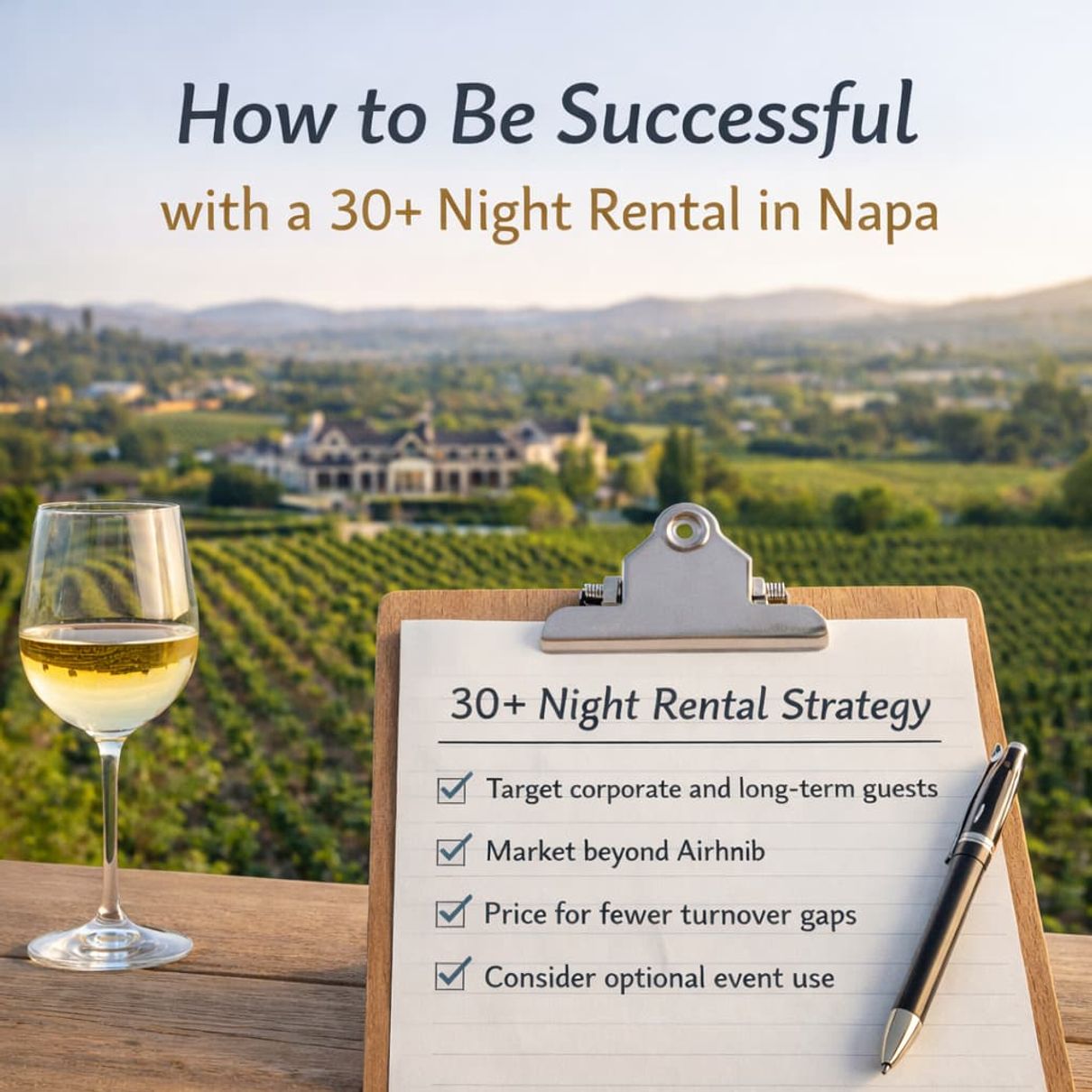
A practical strategy for owners operating within Napa’s rules
If you’ve looked into short-term rentals in Napa, you’ve likely already realized something important: this is not a market where traditional short-term rental strategies work easily.
Permits are limited, rules are fragmented by jurisdiction, and many owners ultimately find themselves operating under 30-night minimum stays, either by necessity or by design.
At first glance, that can feel like a constraint. In practice, for the right property and the right strategy, it can be a different but very viable hospitality model.
This article explains how owners are successfully operating 30+ night rentals in Napa, what tends to work, what doesn’t, and where additional upside can exist for certain properties.
A quick framing note
This guide is intentionally strategic rather than regulatory.
It assumes you are already operating legally under Napa’s rules, often with a 30-night minimum stay requirement, and are asking the next question:
“How do I actually make this work financially?”
Not every home is a good fit for this approach. The strategies below work best for high-quality, well-located homes with strong fundamentals. That said, many of the principles can be adapted for non-luxury properties as well.
The reality of Napa today
In practice, Napa has become a market where:
- Traditional short-term rentals are limited, capped, or unavailable in many areas
- Many owners default to 30+ night rentals because it’s the clearest legal path forward
- Success depends less on nightly rate optimization and more on utilization, positioning, and demand targeting
The mistake many owners make is treating a 30-night rental like a discounted version of a short-term rental. That approach usually underperforms.
The owners who do well think about their property differently.
Why many 30+ night rentals struggle in Napa
Before talking about what works, it’s worth calling out what typically doesn’t.
We see underperformance when owners:
- Price 30+ night stays by simply discounting nightly STR rates
- Rely entirely on Airbnb or VRBO without broader marketing
- Use generic listing copy that doesn’t speak to long-stay needs
- Leave long vacancy gaps between stays due to narrow demand targeting
In other words, the property may be legal, but the strategy is passive.
The professional 30+ night model (what actually works)
Successful long-stay rentals in Napa are run less like vacation rentals and more like temporary residences with hospitality infrastructure.
Here are the core elements.
1. Target the right long-stay demand
The most reliable 30+ night demand in Napa typically comes from:
- Wine industry professionals (harvest season, consultants, executives)
- Corporate relocations and interim housing
- Executives and entrepreneurs using Napa as a base
- Production, media, or brand teams working on multi-week projects
- Extended leisure stays where guests want a true “live-in” experience
These guests care less about “vacation vibes” and more about:
- Space
- Privacy
- Comfort
- Predictability
- Professional management
Your marketing should reflect that.
2. Position the home as a residence, not a getaway
This is a subtle but important shift.
High-performing long-stay listings emphasize:
- Livability over novelty
- Work-from-home functionality
- Storage, parking, and privacy
- Clean, neutral, well-maintained interiors
Luxury helps here, but clarity matters more than flash.
For non-luxury homes, the same principle applies: show that the home works well for daily life, not just weekends.
3. Market beyond traditional STR platforms
Airbnb and VRBO can still play a role, but they should not be the only channel.
Successful operators layer in:
- Direct marketing and inquiry handling
- Broker and relocation relationships
- Corporate and industry-specific outreach
- Production and executive housing channels
This is where professional operators tend to outperform individual owners. The demand exists, but it doesn’t always find you automatically.
4. Price for continuity, not spikes
A strong 30+ night strategy prioritizes:
- Fewer turnovers
- Longer average stays
- Lower vacancy between bookings
That often means:
- Thoughtful monthly pricing
- Flexibility around start and end dates
- Willingness to trade peak pricing for continuity
The goal is steady utilization, not short bursts of high ADR.
Optional upside: events, retreats, and non-lodging use
For certain properties, there can be additional upside beyond lodging.
This is not a workaround for rental rules, and it’s not appropriate for every home. But when done correctly, non-lodging use can complement a long-stay strategy.
Examples include:
- Corporate offsites or strategy retreats
- Wine industry tastings or brand events
- Small executive gatherings during vacancy gaps
A few important caveats:
- Events are not lodging and are regulated separately
- Zoning, noise, occupancy, and insurance rules still apply
- This works best for properties with the right layout, location, and separation from neighbors
For luxury properties in particular, this can help smooth cash flow without increasing guest turnover.
This approach won’t work for every house
It’s important to be explicit about this.
This model works best when a property has:
- Strong fundamentals (location, quality, layout)
- A price point that supports longer stays
- A use case that aligns with Napa’s demand profile
For non-luxury homes, elements of this strategy can still apply, but expectations need to be realistic. Not every home is suited to executive or corporate demand, and that’s okay.
The key is alignment, not force-fitting a strategy.
How Recreation Stays approaches Napa properties
We manage luxury properties in regulation-heavy markets where owners need more than a generic STR playbook.
In Napa, that typically means:
- Designing a long-stay strategy that fits the property and the rules
- Layering demand sources beyond traditional STR platforms
- Managing occupancy and calendar continuity intentionally
- Handling tax, reporting, and compliance requirements correctly
- Exploring complementary uses like events only when appropriate
Our role is not to push one model everywhere, but to match the strategy to the asset.
Final thought
Napa is no longer a market where success comes from simply “turning on Airbnb.”
For many owners, the path forward is a thoughtful 30+ night strategy, sometimes paired with complementary uses that respect local rules.
Done well, this approach can produce stable income, lower operational friction, and a more professional hospitality experience.
If you’re evaluating a Napa property or rethinking how an existing one is operated, clarity upfront goes a long way.
Schedule a Consultation | Get Your Revenue Analysis | See Our Portfolio