
How to Get a Seattle Short-Term Rental License
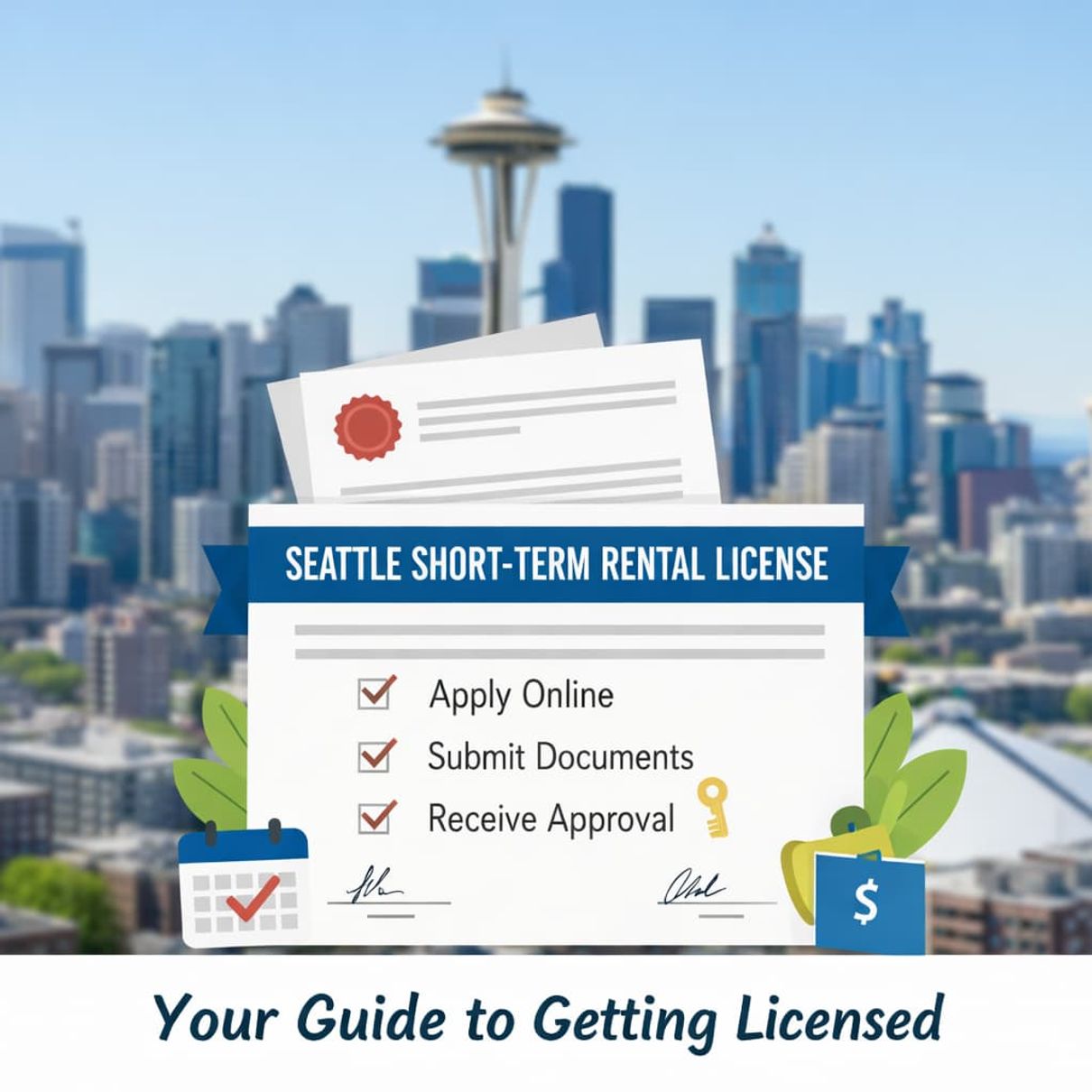
A clear, step-by-step guide for owners
Before diving in, one important note.
This guide is intentionally detailed, and at first glance it may look like a lot. In practice, the process itself is quite simple. For most owners, it comes down to choosing how you want to operate and filling out a series of required forms.
We’ve made this guide longer and more comprehensive on purpose. It’s designed to:
- Preempt the most common questions we’re asked by owners
- Clarify points that are often misunderstood or oversimplified
- Help you avoid delays, rework, or compliance issues later
So while the post is thorough, the actual process is straightforward. Don’t let the length overwhelm you. You can move through it step by step, and most owners find that once they start, it’s largely administrative.
Think of this as a reference guide you can skim now and return to as needed.
If you are planning to operate a short-term rental in Seattle, one of the first things you need to understand is licensing. The City’s rules are defined, but the process can feel opaque if you have never gone through it before.
This guide walks through the entire Seattle short-term rental licensing process, step by step, in plain language. It explains what is required, what decisions you need to make along the way, and what responsibilities stay with you as the owner.
This is intended to be evergreen, practical content you can reference as needed. Regulations can change, so you should always confirm details with the City before applying.
Important disclaimer
This article is general informational guidance only. It is not legal advice or tax advice, and it does not recommend one ownership or tax structure over another.
Before deciding how to structure or operate a short-term rental, you should speak with:
- A qualified CPA or tax advisor
- A qualified attorney
This is especially important if you have multiple owners, significant personal assets, or long-term plans to scale.
Step 1: Understand who is legally responsible (even if you hire a management company)
The Seattle STR Licensing Checklist:
- Determine Ownership (Individual vs. LLC)
- Apply for Seattle Business License Tax Certificate
- Apply for Seattle STR Operator License ($75/unit)
- Register for RRIO (if applicable)
- Display License Number on all Airbnb/Vrbo listings
Before getting into forms or applications, it’s important to understand how Seattle assigns responsibility.
Even if you plan to hire a short-term rental management company, vacation rental management company, or Airbnb management company, the property owner is still responsible for licensing and compliance in Seattle.
In Seattle:
- The Short-Term Rental Operator License is issued to the owner or operator, not the management company
- Hiring a management company does not transfer licensing responsibility
- The City looks to the owner as the accountable party, regardless of who handles day-to-day operations
A professional management company can help guide you through the process, flag requirements, and manage ongoing compliance once a license is in place. But they cannot hold the license in place of the owner.
Because of this, every Seattle short-term rental owner should understand the steps below, even if they never plan to self-manage the property.
Step 2: Understand Seattle’s short-term rental limits
Before applying for any licenses, you should understand what Seattle allows.
Under Seattle’s current short-term rental rules:
- An operator may generally license up to two short-term rental units total
- If you operate two units, one of them must be your primary residence
- If you operate only one unit, that unit does not have to be your primary residence
Put simply:
- You can operate one non-primary-residence short-term rental in Seattle
- To operate two units, Seattle requires that one of the two be your primary residence
This distinction matters. Many owners assume all Seattle short-term rentals must be primary residences. That is not accurate. The primary-residence requirement only applies if you want to operate two licensed units.
There are limited legacy exceptions under older rules, but most new owners should assume the limits above apply.
Step 3: Decide how you will operate (Individual vs Washington LLC)
Before applying for Seattle licenses, you need to decide who the City is licensing.
You generally have two options:
- Operate as an individual (sole proprietor)
- Operate through a Washington LLC
There is no universally correct choice. The right structure depends on tax treatment, liability considerations, ownership structure, and long-term plans.
This is where speaking with a CPA and attorney is especially important.
Step 4A: If operating through a Washington LLC
If you plan to operate the short-term rental through an LLC, there are additional steps before Seattle licensing. Start here if you plan to do that. If not, go to Step 4B:
1. Form the Washington LLC
You must first create the LLC with the Washington Secretary of State. This is done online here: https://www.sos.wa.gov/corporations-charities/business-entities/online-filing-instructions/start-domestic-wa-limited-liability-company-llc-online
You will need:
- An available LLC name
- A registered agent
- Member or manager information
Once approved, the LLC legally exists in Washington.
2. Apply for a Washington State business license and UBI
After forming the LLC, apply for a Washington State business license through the Department of Revenue. This is how the business receives a UBI (Unified Business Identifier).
The UBI is used across state and local registrations.
3. Apply for your Seattle Business License Tax Certificate
Once the LLC exists and has a UBI, apply for the Seattle Business License Tax Certificate under the LLC through FileLocal.
Only after this step should you move on to the short-term rental license.
Step 4B: If operating as an individual (sole proprietor)
If you choose to operate as yourself, your path is straightforward:
- Apply for a Seattle Business License Tax Certificate: https://www.filelocal-wa.gov/
- Apply for a Seattle Short-Term Rental Operator License: https://services.seattle.gov/Portal/Customization/pages/strn.aspx
- Register for RRIO, if required: https://www.seattle.gov/sdci/codes/licensing-and-registration/rental-registration-and-inspection-ordinance
- Post your license number on all listings
You do not need to form an LLC for this option.
Step 5: Apply for the Seattle Business License Tax Certificate
All Seattle short-term rental operators must have a Seattle Business License Tax Certificate, whether operating as an individual or an LLC.
Key points:
- Applications are handled through FileLocal: https://www.filelocal-wa.gov/
- Processing is not always instant, so allow time
- This license renews annually
Your business license must be active before applying for the short-term rental license.
Once your license is active, you’ll need to stay on top of Seattle’s 2026 STR Occupancy Taxes to remain compliant.
Step 6: Apply for the Seattle Short-Term Rental Operator License
Once your Seattle business license is active, apply for the Short-Term Rental Operator License through the Seattle Services Portal: https://services.seattle.gov/Portal/Customization/pages/strn.aspx
What to expect:
- The license is issued per dwelling unit
- The fee is $75 per unit per year
- If applying under an LLC or partnership, additional members may need Portal accounts as part of the workflow
Operating or advertising a short-term rental without this license can result in enforcement action.
Step 7: Register for RRIO if required
Seattle’s Rental Registration and Inspection Ordinance (RRIO) applies to many rentals that are not the operator’s primary residence.
If required, RRIO involves:
- Registering the property with SDCI
- Periodic inspections to confirm basic housing and safety standards
RRIO is separate from the short-term rental license and is commonly overlooked.
Step 8: Add your license number to every listing
Seattle requires your Short-Term Rental Operator License number to be clearly displayed on every listing, including Airbnb, VRBO, and direct-booking websites.
Seattle specifies formatting requirements, and this is one of the easiest compliance items for the City to verify.
Our Seattle STR management team handles the entire licensing process for clients
Ongoing responsibilities owners should understand
Licensing is not a one-time task. Owners are also responsible for:
- Lodging and sales-related taxes, especially for direct bookings
- Annual license renewals
- Maintaining safety and habitability standards
- Complying with Seattle’s reporting and enforcement rules
If you operate multiple units in a single building or complex, additional state health licensing requirements may apply.
Common mistakes we see
- Assuming a management company handles licensing on the owner’s behalf
- Applying for the short-term rental license before the Seattle business license is active
- Forgetting RRIO when it applies
- Misunderstanding the two-unit limit and primary-residence requirement
- Failing to post the license number on listings
Most of these issues are avoidable with upfront planning.
Final thought
Seattle allows short-term rentals, but it does so deliberately. Owners who understand the rules before buying or converting a property tend to have far fewer surprises later.
Even if you plan to work with a professional management company, understanding the licensing framework puts you in a much stronger position as an owner.
Links you’ll actually need
Seattle business license (required for all operators)
Apply for your Seattle Business License Tax Certificate here:
https://www.filelocal-wa.gov/
Seattle short-term rental license
Apply for the Seattle Short-Term Rental Operator License through the Seattle Services Portal:
https://services.seattle.gov/Portal/Customization/pages/strn.aspx
Washington LLC registration (only if you choose to operate through an LLC)
Form a Washington LLC with the Secretary of State here:
https://www.sos.wa.gov/corporations-charities/business-entities/online-filing-instructions/start-domestic-wa-limited-liability-company-llc-online
How Recreation Stays can help
We manage short-term rentals and boutique hospitality properties throughout Seattle and other regulation-heavy markets. While the licensing process itself must be completed by the owner, our role is to make operating the property simpler and lower-risk once it’s live.
In particular, we help owners with:
- Occupancy and lodging tax handling
We handle the setup, tracking, and remittance of required occupancy and lodging taxes across platforms, including direct bookings, so owners don’t have to reconcile this themselves or worry about missed filings. - Ongoing compliance support
Once a property is licensed, we help ensure listings remain compliant, renewals are not missed, and required information stays up to date as rules evolve. - Operational execution
Guest communication, pricing, cleaning coordination, maintenance, and day-to-day operations are handled using hotel-grade systems designed to reduce owner involvement without cutting corners.
It’s worth noting again that Seattle licenses the owner, not the management company. Our job is not to replace that responsibility, but to support it with systems, experience, and oversight so owners can operate confidently without needing to become experts themselves.
If you’re evaluating whether a short-term rental makes sense in Seattle or already own a licensed property and want a more professional operating setup, we’re always happy to have a straightforward conversation.
Explore our Seattle Airbnb Management and Pricing & Services pages to see how it works.
Curious how much your property could earn?
Use our Rental Income Calculator for an instant estimate, or request a consultation for a personalized profitability analysis.
Schedule a Consultation | Get Your Revenue Analysis | See Our Seattle Portfolio

With 25+ years in luxury hotels and vacation rentals, Adam has led operations for brands like Fairmont and St. Regis and built high-performing hospitality businesses from the ground up. Today, as Founder & CEO of Recreation Stays, he brings that same expertise to helping owners unlock maximum returns while delivering five-star guest experiences. He’s also the host of The Proven Principles Hospitality Podcast, where industry leaders share what works in modern hospitality, and was recently recognized as one of the Top 100 Most Powerful People in US Hospitality.